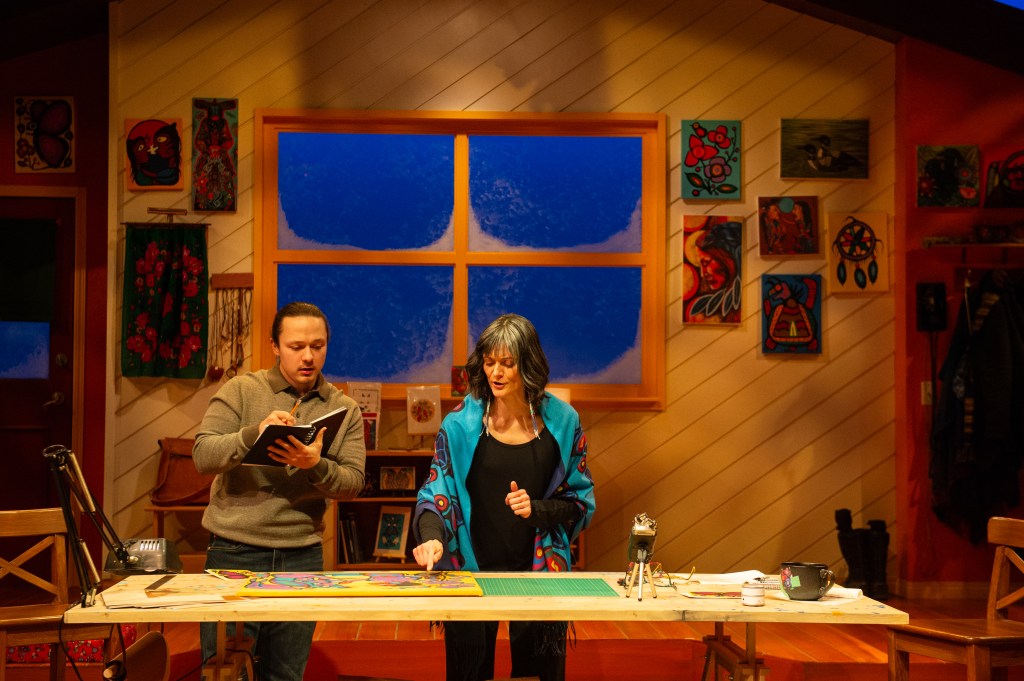
Calla Adubofour-Poku, Vinnie Alberto, Charlene Van Beukenhout
Director: Tracey Nepinak Set & Props Designer: Adam Parboosingh Costume Designer: Amy McPherson Lighting Designer: Anika Binding Sound Designer/Composer: Ryan Black Stage Manager: Michael Duggan Assistant Stage Manager: Michelle Lagassé Sound Design Mentor: Dasha Plett Vocal Coach: Shannon Vickers
By Daniela Smith-Fernandez
How do you measure cultural authenticity? More importantly, who gets to make those judgement calls and how should they go about it? These are some of the deep, complex, contradictory questions that drive this piece, and drive it do they ever. The story uses the case of the many, many frauds of Anishiinabe artist Norval Morisseau to address issues of indigenous heritage and the ownership of cultural knowledge. The show takes place in the home that main character, Nizhi Nigig shared with her late husband, a famous Anishinabe painter on Otter Lake reserve, a beautiful space bright with colour and pan-indigenous imagery. She has built a career as an expert in indigenous art, publishing multiple articles, curating shows, running an art gallery and, significantly, being able to identify Norval Morisseau forgeries. The show’s title comes from a existence of a particular colour of paint which allows Nizhi to tell that a piece is fake. This motif becomes extremely important when an indigenous reporter comes to interview her and discovers things in her past which threaten the world of her and her daughter Beverley.
The pacing in this play is beautifully done -the direction from Tracey Nepinak keeps you unsettled and on the edge of your seat.. Unfortunately the suspense and rolling out of the story makes it very hard to talk about without revealing too much about the show. I’ll do my best to keep away from spoilers, because this is a show I highly encourage people to experience for themselves. I will, however, say that I was completely turned around between scenes one and two. In the first one something felt off about Nizhi even though all the elements were technically there. She was passionate about fraud identification, but nothing she said seemed all that noteworthy or radical. I was just about to sigh and prepare myself for a play that talked at me about how Indigenous art fraud is Exceptionally Bad with Extra Helpings of Colonial Exploitation – unmistakeably true but not always exciting theatre… Then the twist comes in and I was completely riveted. It turned out that all of that nagging feeling of unease was completely deliberate and a huge part of why the show was so exceptional.
We need to talk about the characters, fleshed out by a fantastic cast. of , Vinnie Alberto. Charlene Van Beukenhout as Nizhi gave an incredibly nuanced and captivating performance as this morally ambiguous person, described within the show as “a bit of a trickster”. She managed to be both sincere, and yet she is also portrayed in a way that draws attention to her problematic life choices. This was grounded in the character of her daughter Beverley, an indigenous educator played by Calla Adubofour-Poku. This character allows us to really feel the damage Nizhi has caused, while also continuing to treat her with compassion and dignity. Vinnie Alberto plays the journalist role with a touch of reverence, severity and hurt that allows us to see her with the eyes of broader indigenous communities. If this issue is one that touches you, it will move you. If it isn’t, this play is compelling enough to offer some emotional education on why this issue matters to the people involved.
A good indicator of how rich this piece is can be seen in the fact I had two long and intense conversations about indigenous identity and cultural authenticity with the friend I took to the play. The next day we were still pulling it apart. I found myself wanting to look for the documentary about Norval Morisseau fraud. I also found myself drawing parallels with the Latin American indigenous art situation, about cooption of traditional motifs and symbols, about how intellectual property rights aren’t really set up to deal with collective knowledge… and then we’re back to the age old issue of how do you balance individual autonomy with responsibility to the collective. Among other things. This is the state of curiosity and creativity that I want to leave the theatre feeling.
It also has a really perfect ending that resolves just enough. I appreciated it.
If “Rogers vs. Rogers” was not my kind of theatre, this very much is. It’s emotionally honest, thought provoking, well performed, beautifully staged, dense and so rich with meaning. I highly recommend this one.
Daniela Smith-Fernandez is Chilean-Canadian by birth, francophone by choice. She is an artist, writer and craftsperson who is proudly multicultural and multilingual (English, Spanish, French). She has worked in theatre as a costumer, prop maker, venue manager and volunteer. Her theatre reviews and articles have been published in student newspapers and blog. She is currently writing the second play in a trilogy about a pansexual man who is obsessed with sex and French grammar, not always in that order. She writes in English and French.


Leave a Reply