By Daniela Smith-Fernandez
Marry Henry VIII when you’re madly in love with someone else and your country is in absolute political and religious turmoil and the only heir is a sickly boy? What could possibly go wrong? Or right? The Last Wife tells the highly fictionalized story of Katherine Parr, the as mentioned last wife of Henry VIII, and how she impacted the royal milieu she was thrust in. If you know anyone who reads historical fiction by the stack, loves Shakespeare interpreted in modern times, or is just really deep into all things tudors – they probably need to know about this piece. It will play delightfully to an older audience who had this history drilled into their heads. Or, unfortunately, anyone who thinks stories from European history automatically have ‘universal appeal’ and expect that most people know them. Be aware that this show is not going to hit as hard if you don’t have some background knowledge going in.
Katherine Parr is not yet a widow when the story begins. Actually, point of fact she’s waiting in the wings for her elderly husband to die so she more openly embrace Thomas Seymour. Unfortunately the boorish Henry VIII comes around to literally present her with an offer she can’t refuse, although she does try to negotiate a little. The deal is she has to educate his heir, Edward, and you know, do all those good female things including sex. Their relationship grows both closer, more intimate, and (in my opinion) significantly more messed up, but of course nothing and no one is a match for Katherine the Great! Wait… wrong historical period… She even gets Henry, or ‘Hal’ to accept his daughters as legitimate! While offering some very saccharine 1950’s style messaging about how they are ‘a family’ now. (I mean, Tudor families continually try to kill each other, so I don’t think that word meant or means what you think it does). Also, because Katherine is just that amazing, she also does smart things in the war and everyone comes to appreciate her. Including Thomas Seymore, who is with us until the end. Spoiler alert: she changed history and made everything better for women. Standing ovation time. Cue the sales at McNally for history and historical fiction books about the Tudors. This show will make a lot of people happy. And the cast and crew deserve that, because they created a solid cohesive show where everyone does their part.
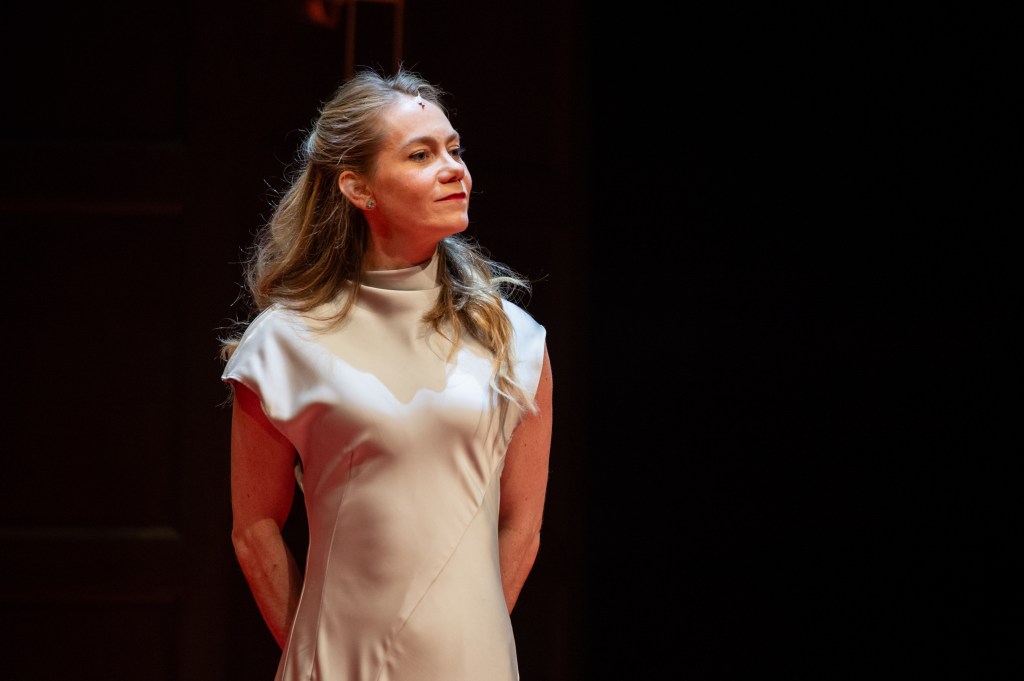
The events are grounded in historical fact but located in the present. The scenery hits notes of Tudor, but the costumes and dialogue are pure modern. This aspect of the show was very effective. Like a really good Shakespeare adaptation, it drew the events and tensions into conversations about the modern day. Also, it was aestheticaly pleasing. The costuming of Katherine Parr was particularly effective, as she was always dressed in clean lines and deceptively simply cut dresses which created contrast between the fussy detailing of other characters. It made her stand out as exceptional -more about that later. Generally every character stuck to a single colour, making them striking against the stark beauty of the set. I particularly like the shifts between Elizabeth’s frilly white girly dresses towards cleaner and more adult expressions. I hated what they did with the character of Mary Queen of Scots, but I thought her gothic lace and crucifix were on point.
Also, Henry VIII is uncomfortably humanized. And surprisingly willing to be led by her, although the show does seem to suggest this is more to do with her being really pretty than her brains. (Sorry but they did not sell me on that one) The acting offers solid interpretations of each character which work with the story the show is telling. It’s also a great show to throw a big production budget at. The direction is great. The costumes and set are great. The acting is on point. My technical brain delighted in all the little nuances brought into everything. And yet.
Where they lost me was with the script itself. And yet I found the play itself so profoundly irritating that they lost me fairly early on. My friend and co-critic Skylar Bélanger was in fine form with the quips, but I think his most on point might have been ‘white woman girl boss feminism’. I was deeply annoyed with how perfect and smart and capable Katherine was. Watch how beautiful and elegant she is! Look, she’s educated and writes books! Oh, she tamed the terrible Henry VIII into someone tolerable! She treats his leg with advanced science! She becomes a mother to royal orphans who now love her so much! Now she’s got strategic smarts! What a woman! Let’s seriously not talk about how her power comes from manipulating her husband with her beauty, and ok, some brains. This is not the feminist achievement we want to believe.
I am so incredibly bored with stories about exceptional heroic impossibly capable people. It feels like a superhero comic for people who wouldn’t be caught dead reading superhero comics. It’s boring, and it’s a tired narrative device, and I want something else. Honestly, she WAS a product of her time, because we all are. What would be wrong about actually examining how women at the time lived without making her into what people want a modern woman to be? Why aren’t characters allowed to have realistic human limits? Especially ones that are based on historical figures?
So there you have it. This play is both well constructed and beautifully executed… while also telling a story that makes me absolutely crazy with its abuse of tired old tropes about AMAZING and EXCEPTIONAL women. I am an extremely strong feminist and want nothing more than stories with a female perspective. This does not meet that need. I want emotional honesty and nuanced characters. That is not met by just taking one of a handful of already known historical women and making her an unrealistic paragon of all things amazing and womanly.
Everyone in this production deserved a better script.
Daniela Smith-Fernandez is Chilean-Canadian by birth, francophone by choice. She is an artist, writer and craftsperson who is proudly multicultural and multilingual (English, Spanish, French). She has worked in theatre as a costumer, prop maker, venue manager and volunteer. Her theatre reviews and articles have been published in student newspapers and blog. She is currently writing the second play in a trilogy about a pansexual man who is obsessed with sex and French grammar, not always in that order. She writes in English and French.


Leave a Reply