By Daniela Smith-Fernandez
Rattle is the story of two sixties scoop survivors, Bobbie and Dan. Beyond that, it is the story of their family and the ways in which trauma never stops at only impacting one person. It’s also a love letter to the community that has been created in the North End, something talked about significantly less than the crime. For those who are unfamiliar with the term, the sixties scoop was when our wonderful and equitable and oh so friendly Canadian government literally took indigenous kids, often babies, forcibly from their parents and adopted them out into white Canadian families. It is an act of cultural genocide and deliberate traumatization which needs to be discussed in this country more than it currently is. Luckily for us, we have people like Root Sky Theatre Company to explore the themes in a meaningful and wonderfully human way.
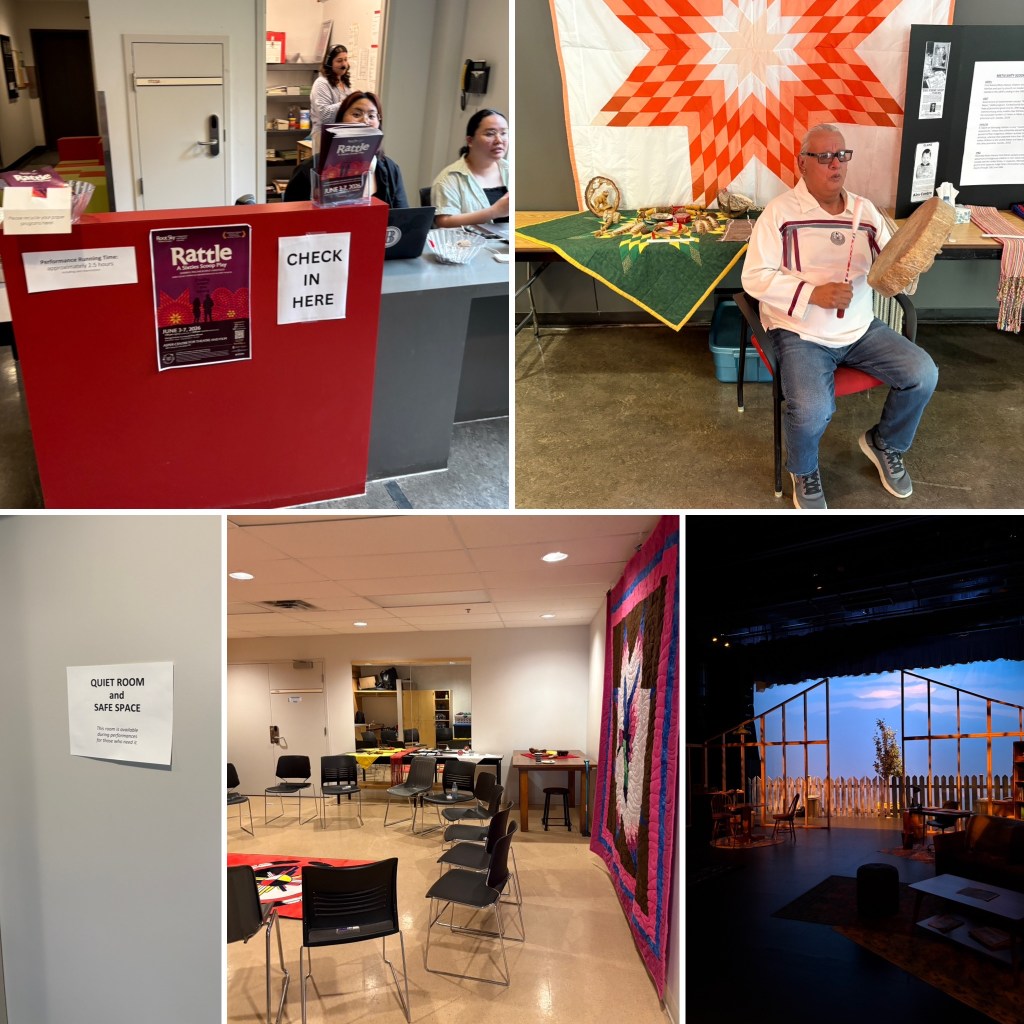
Normally with a review, it makes sense to include a press photo. Something iconic that represents the show, which is what we want when we’re talking about it. This time it felt more appropriate to highlight the way in which the piece was made and presented that was distinctive. In an interview with director Charlene Van Buekenhout, she talked about all the ways in which the production was structured in order to be aware and supportive of trauma. For example, you can see in the pictures above that you were created by a drummer singing you in as you got your ticket. Right next to the stage there is a Safe Space with people available to help those who need extra support due to the experience of the play. They have water, and medicines, and people to talk to and help ground you. In other words, there has been every effort to make this a safe space to experience difficult feelings. No one is left to feel painful emotions alone. Which is compassionate, and smart, and honestly why isn’t this the way every theatre production deals with potentially traumatic themes? This effort of care would make this show noteworthy even if it weren’t an exceptionally good and well crafted piece, which it was.
When the story starts, Bobbie is off work due to having a cancer operation. Dan, who works for the MMF, is pushing her to get her child and family records and sign his petition to compensate sixties scoop survivors. While he burns with an evangelical fire, she is clearly more traumatized by this than the cancer, and unable to communicate with her friend as to why that is. Bobbie’s son Jordan loves his mother but struggles to understand her, is missing his deceased father while trying to assert independence from a parent with serious abandonment issues. In the other household, Dan’s wife Lena, a nurse, is desperate to move out of the North End and ensure their daughter Crystal’s future. Crystal, on the other hand, has inherited Dan’s sense of needing to stand up to injustice – even when it goes directly against the desires of her parents. Oh, and somewhere in the middle of this chaos Jordan and Crystal manage to fall in love in the sweetest and most authentic young love story I’ve seen in a long time.
Characterization is definitely the greatest strength of this piece. Which is no slight on the beautifully lived in set and on point costuming. Jordan and Crystal stand out as really good examples of North End teens with the strong sense of place and kick ass attitude you can often find in youth there. The writing is tight and evocative, giving every person the chance to be authentic and say their truths in a way that lets you know they have solid arguments… and yet… the real strength is that every well thought out sincerely held belief is presented as an only partial truth. For example, the dialogue given by Lena is absolutely brilliant. She is both incredibly caring, listens, and is somehow also insensitive to her family’s needs – while never being less than supportive of the sixties scoop case. That kind of moral complexity takes some real skill to capture, and it pays off.
One of the most effective contrasts in the piece is between the ways that Bobbie and Dan have dealt with their sixties scoop experience. Initially it seems like Dan has moved on from what he went through, got his papers and is now fighting the good fight. On the other hand, Bobbie struggles to be alone and refuses to look at her documents. As it goes on, this simple dichotomy gets muddied very quickly. We find out that Dan almost died going on a bender and abandoning his family when he got his court records. On the other hand, Bobbie is much more aware how this information could destroy her and protects herself – she has more self-awareness than Dan, even if it seems like she’s avoiding the truth. Bobbie’s refusal to see information hurts her, but Dan’s evangelical zeal to make everyone confront their past is just as problematic.
The through line is that all this personal emotional damage is the direct responsibility of the Canadian government, who doesn’t have to be there as individuals sort through the ways this has impacted their lives. Bureaucracy is a matter of cold impersonal paperwork, but the ways in which it impacts people’s lives is messy, painful and excruciating and most importantly re-traumatizing. Rattle calls for a more compassionate way of offering healing and reparations to survivors. Offering compensation is ineffective when it means that the person has to go through it again.
It’s hard not to describe this show as though it’s very serious, but the truth is the show isn’t even if the ideas are. It’s actually a lot of fun. It’s a sweet story of found community and people who are committed to each other. Of healing, love, and the power of community. By the time the end rolls around, I felt like I was watching the most satisfying best resolved happy ending in the world. Which is saying something, because on a federal level nothing has actually changed. At the same time, the characters in this story have built a world for themselves that is warm, loving, full of connections and laughter. It feels good, and it is very healing.
This production highlights my long held belief that some of the most exciting, creative and interesting theatre happening in Winnipeg is coming out of the indigenous community.
Daniela Smith-Fernandez is Chilean-Canadian by birth, francophone by choice. She is an artist, writer and craftsperson who is proudly multicultural and multilingual (English, Spanish, French). She has worked in theatre as a costumer, prop maker, venue manager and volunteer. Her theatre reviews and articles have been published in student newspapers and blog. She is currently writing the second play in a trilogy about a pansexual man who is obsessed with sex and French grammar, not always in that order. She writes in English and French.


Leave a Reply