By Daniela Smith-Fernandez
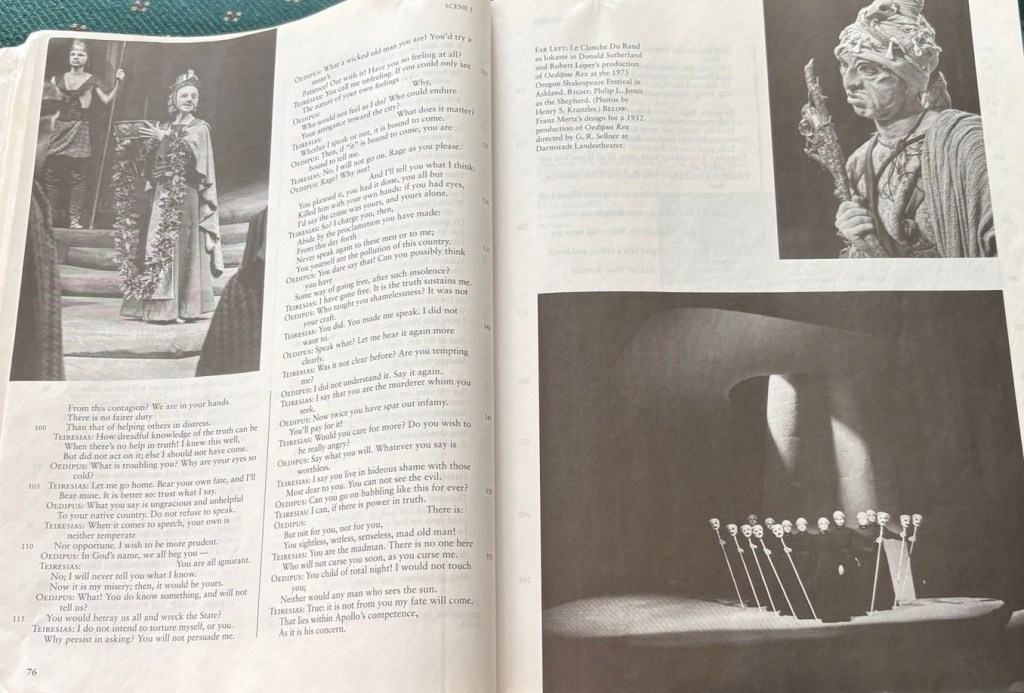
There are plays you read because the plot is compelling and you want to find out what happens. This is not one of those plays. What’s interesting is that this textbook explains that the Ancient Greeks also came to this play knowing the characters, the story it was based on, and what was going to happen at the end. So much of the time Western storytelling focuses on the surprise ending, the big shock and awe. When you read plays like this you have to adjust your expectations. Instead of focusing on what will happen, the emphasis is on how you get there. What goes into the unraveling of plot. This is something I have to remember is an option when I write: there are many ways to capture tension, and if you do it properly your work can be enjoyed multiple times.
Most people, including those who aren’t much for Greek mythology, are aware that Oedipus is the guy they named the complex for. In the off chance you don’t know more than that, here is the summary: as a baby a prophecy is made that prince Oedipus of Thebes will kill his father, the king, and marry his mother Jocasta the queen. Since this is pretty unacceptable for everyone involved, his doting parents leave him to die on the side of the road, because apparently infanticide seems to have been pretty acceptable in ancient Greece. As it happens, a poor shepherd couple find Oedipus and raise him as their own. He finds out about the prophecy and leaves to save his parents. Along the way to Thebes he comes across an old guy who he kills on the road. Oops. Then he stumbles across the Sphynx who has been asking people a riddle and killing them when they’re wrong. He, however, gets it right and is crowned king of Thebes, also accepting their offer to marry the king’s widow. Then at some point there is a blight on the land and wise sages say that the misfortune is happening because the old king’s murderer has not been punished. That’s where the play starts.
It’s always a little strange to talk about Greek theatre because they often require background knowledge and readings. When Oedipus Rex starts we as the audience understand intrinsically that this man is doomed, as we follow his righteous investigation into the death of the kind. For me, what stands out in this play is the tension between Oedipus’ self-righteousness and the doom we all know is coming. By all metrics, it doesn’t seem like he’s a bad king. At the beginning he’s energetically seeking out advisors and prophets alike looking for evidence. It has the feel of a detective show to be honest, with him setting out to find the truth at all cost. At the same time, so many people tell him to turn away, that nothing is going to come out that will be worth him knowing. He turns away priests for being unhelpful. He is insistent on chasing down people who were there at the king’s murder so long ago. He is trying so hard, and the closer he gets the deeper in it he is. When he finds out the truth he gouges out his eyes and goes to wander the earth, leaving the king’s brother Kreon in charge. Next entry is about him.
To be this is the classical example of a tragedy in the truest theatrical sense of the word. You have Oedipus who wants nothing more than to do the right thing all the way through his life… and yet he ends up in the same doomed place. I wonder as I read this text how he was as a son to his adopted parents. Clearly he loved them enough to try to avoid killing them. He defeated the monster who was terrorizing a population only to be the source of their distress down the road. He married this woman, had four children with her, consulted with her… and it turns out it was incest all along, one of the only universal taboos out there. From the perspective of intent, none of this is the work of an objectionable mind who is trying to deliberately cause harm. It’s someone who circumstances twisted out of shape. At the end, Oedipus feels that the only thing he can do is blind himself, and that’s what he does. So much suffering, and so little of it can be attributed to maliciousness.
As a former anthropology student, I feel like this is partially supposed to be a parable about the importance of tracking genealogy. Or the dangers of infanticide, that is another big issue. Regardless, keep track of relatedness. There is a reason why old epic poems often dedicate pages and pages to who descended from whom. Even if they aren’t always fun to read.
This play is an object lesson in building tension. Even reading it I can feel the horror as that ambiguity at the centre of the story is revealed. I want to create characters as morally complicated as Oedipus Rex without rewriting the story. How do you make the reader feel for someone who is doomed? Where do you go next?
I just don’t know.


Leave a Reply