By Daniela Smith-Fernandez
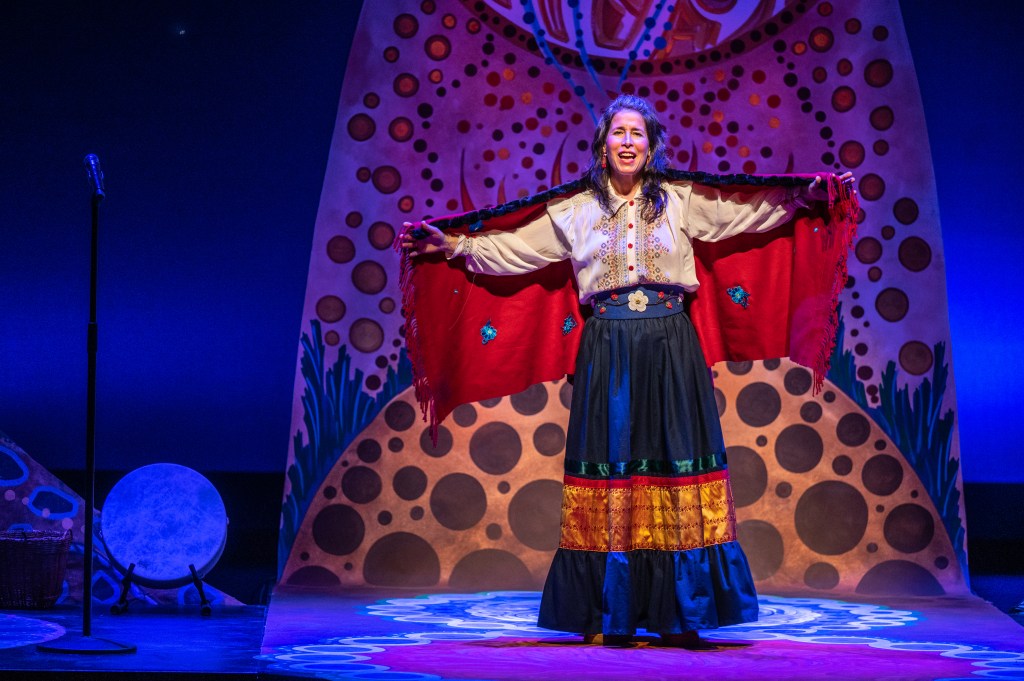
Rubaboo, as it is explained to us on stage, is the Michif word for stew – specifically the everything you have in your fridge and-or-pantry kind of stew. It is an appropriate name for this creation, described as a Métis cabaret, a performance experience which is not entirely a traditional theatrical play. You have music, both songwriting and traditional, storytelling, anecdotes, ceremonies, teachings about the four elements, and even some jigging. It’s not so much unified by a narrative thread as a link to Métis culture and identity. Also, Andrea Menard can sing. The creator and main performer of Rubaboo, has a voice on her that you feel in your bones. I’ve seen her act before in other productions and always been impressed, but her musical talents are worth experiencing. It is also a very elaborate production, between musical arrangements and small costume changes and a set which was stunningly beautiful.
For this particular show, I actually had three consultants; Skylar Bélanger, my usual plus one, and also Arianne Mulaire and Janet La France, two Métis friends who went to the dress rehearsal and consulted with me afterwards. In the same way as I try to get a child’s opinion of Manitoba Theatre for Young People shows, I wanted to get a Métis perspective on the cultural components of this show. Especially since they are advertised front and centre. Their opinions are shared with their full permission.
There were two central metaphors working through the show, often competing and at odds with each other. One was the stew mash up, and the other was the four elements. The ideas presented with the elements was symbolically stronger than that of the stew. For me the poetic descriptions of what elements did were some of the best parts of the piece. There was some discordance for me in that it felt strange to be hearing these ideas inside on a theatre seat instead of outside where I connect to the earth and process slowly and deliberately. Something I love about theatre is the ritual quality of a performance, in which energy builds and circulates between the actors and the audience. The energetic exchange felt odd in this show, as though it was just too many people and not enough intimacy for ideas to really soak in. On the other hand, I love that Menard used ritual within the theatre to frame the show, making use of that very dynamic. I think it needed to be tweaked to create the intimacy, but I love the concept and think it has potential.
Everyone in my theatre-going gang agreed that the show was uneven, but interestingly enough there was some disagreement as to where the weak spots were. For me it was tone, in that there weren’t enough dynamic shifts within the night. I also found that the storytelling pieces weren’t up to par, which is worth mentioning because I love oral storytelling enough I considered going to grad school to study it. On the other hand, Skylar wasn’t crazy about the songwriting pieces, saying that they all kind of sounded like 90’s folk. That’s my jam, so it didn’t bother me. On the other hand, my Métis friends had issues with the historical part, claiming that there were some factual errors. Also, the issues brought up tended to be pan-indigenous as opposed to specific to the Métis legacy.
Common consensus is that the goose song was delightful, if historically improbable. No notes on the fiddling, jigging or traditional drum songs either.
There is an issue that needs to be addressed, and that is representation. Watching this piece, it felt very clear that this was directed towards a largely non-indigenous audience as Menard repeatedly offers cultural explanations throughout the show. There is nothing wrong with that, but it did feel a lot like it was making indigenous culture palatable for white people in a way that was non-threatening. That is a really complex issue, which I probably shouldn’t mention – except that it also seems really important to acknowledge. This feels like the kind of show that doesn’t challenge people and get in their faces about complicated political or historical truths, meaning that audience members can walk out without having to in any way confront their own biases. Is this making culture accessible in a positive way, or a cop out that lets people feel good about themselves and how progressive they are? I don’t know. It’s not my culture so this is not where I have a horse in the race, but it is worth thinking about.
This is a case where I love the fact that this piece exists more than the piece itself. I want to see more artists playing with format, indigenous written and performed pieces, shows that play with the ritual side of theatre. For me, the part that I wanted more of was eclectic nature of a true cabaret show, something with a variety of visions and performances. To me that’s what the genre means. Andrea Menard is wonderful, but she presented one vision and one style of theatre. I just wanted more diversity. It was fun, the music was beautiful, and there was a lot to love… but this wasn’t one of my favourites this year.. And honestly, I’ve been looking forward to it since I first saw the poster last summer.
This review also marks the end of this year’s main theatre season. I will be around covering summer productions but not Fringe, as I’m presenting my first play this year.
Thank you for reading, and I look forward to being back reviewing in September!
Daniela Smith-Fernandez is Chilean-Canadian by birth, francophone by choice. She is an artist, writer and craftsperson who is proudly multicultural and multilingual (English, Spanish, French). She has worked in theatre as a costumer, prop maker, venue manager and volunteer. Her theatre reviews and articles have been published in student newspapers and blog. She is currently writing the second play in a trilogy about a pansexual man who is obsessed with sex and French grammar, not always in that order. She writes in English and French.


Leave a Reply