By Christopher Douglas
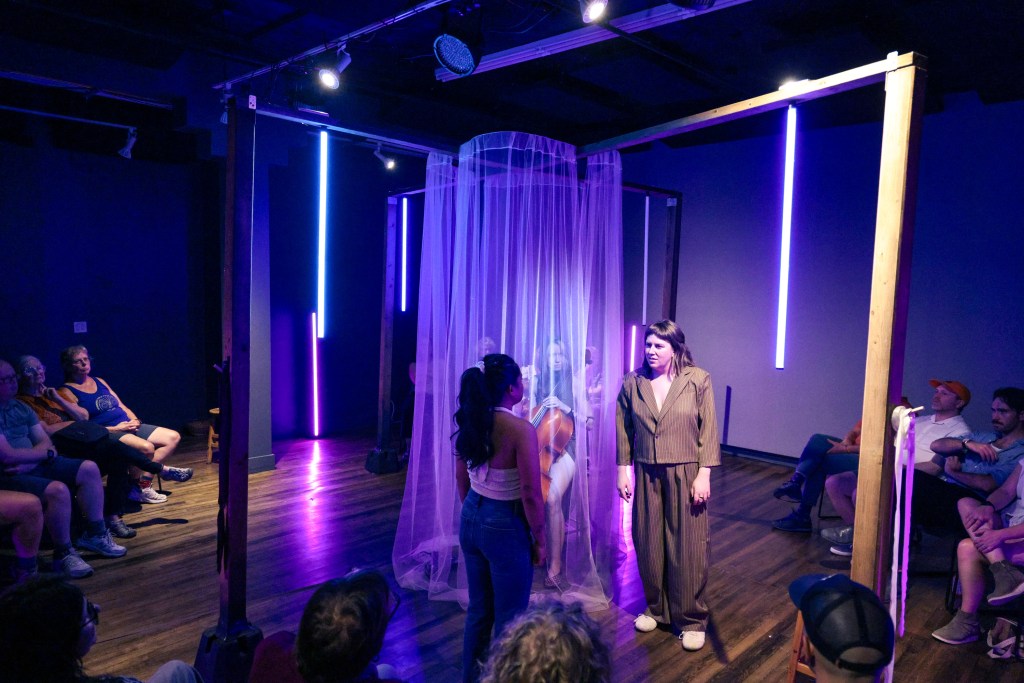
In a room without windows in downtown Winnipeg grows a tree. This tree’s deep roots remember Ovid’s ancient stories and, at the centre of a gallery on the second floor of Artspace, its trunk can be located. Trees are a central image within Sap, Rafaella Marcus’ debut script, presented in this fluid staging by Elio Zarrillo. The audience seating is divided into quadrants spaced around a cylindrical shaft of translucent fabric – the tree’s trunk – at the core of the playing area. Actors move in and around the audience, creating a sense of intimacy (especially with a capacity of fewer than forty people) that echoes the script’s themes.
The sap flowing through the veins of this tree are the words spoken aloud. In a steady address directly to the audience, the play’s nameless protagonist (Hera Nalam) guides us through her leafy hallucinations, her everyday life working at a women’s charity, and a lunch that introduces her to a lawyer referred to as ‘that guy’. The script’s humour shines through when that guy is described as being just what you imagine when you think of ‘that guy’ who would wink at you while scrolling Tinder, Bumble and Hinge. Nalam lands these punchlines with aplomb before steering bravely back to the story.
Sex and danger and vulnerability crack through the tree’s bark when the pair meet again. The edgy sexuality of the show is discussed and frequently abstracted in the staging, but its visceral nature merits the warning the company offers.
The ground shifts when our protagonist then mentions her bisexuality. She seems content with it but not confident enough to tell everyone. Post interactions with ‘that guy’, the lead sets out to a club and locks eyes with her ‘wonder woman’. A new relationship is forged, where our lead does not speak of her history with men. Of course, secrets come with consequences and inhibit growth.
The other characters in our protagonist’s greenhouse are played by Liz Whitbread, using swagger for ‘that guy’ and a sensual nonchalance for ‘wonder woman’ or a great bit of vocal fry for a receptionist at work. The playwright cleverly suggests this multitasking for the second actor and it pays off. Sap’s twists are logical in hindsight and can sometimes be anticipated as the script unfolds, but you will be kept wondering if they’re really going to go there before your jaw hits the forest floor when they do, as when the folks around me leaned forward, shifted, and gasped leading up to each of the show’s reveals.
The heart of the tree resides in that fabric sheath where Grace Morningstar, dressed in shades of green, takes a seat with her gleaming red wooden cello. This production adds the element of live music, and borrows the very human sound of the cello to underscore our narrator’s thoughts and provide punctuational screeches or blats during conversational scenes. Also credited as composer, Morningstar uses a loop pedal to layer rhythm and melody that pulsate towards the light. This musical humanity adds beauty to the play’s natural metaphors, creating its own commentary on the action.
However, unfortunately, when both speakers are on the floor, they can be hard to see across the room.
At 100 minutes, the production could use some pruning, but the gentleness behind the major set change justifiably offers breathing room during a chaotic moment. The lighting and set are simple and effective, evoking the strength of branches held up to the sun.
Near the tree at the core of Sap …through this modern and verbose script
***************

Christopher Douglas (he/him) has primarily been a producer or stage manager. He has worked on 40+ productions in a variety of venues including parks, a bed-and-breakfast, a former coffin factory, and on a literal island. His short plays and adaptations have been performed in academic and festival settings and he is currently exploring poetry and libretti. He has (very) occasionally been convinced to act. As a reader, he devours award-nominated scripts and, as a critic, he has a history of being outspoken. A Torontonian by birth and a graduate of York University, he now lives in Winnipeg.
 Curtains Up Winnipeg
Leave a comment