By Daniela Smith-Fernandez
Curtains Up is now doing book reviews of published plays. Due to a work conflict, they can’t be local to Manitoba. Due to logistics, they have to be printed by a publisher who is willing to send me a review copy. Nevertheless, I am deeply excited to start this chapter of the blog thanks to Playwrights Press Canada. Thank you for working with us, and we’ll do our best to do you proud.
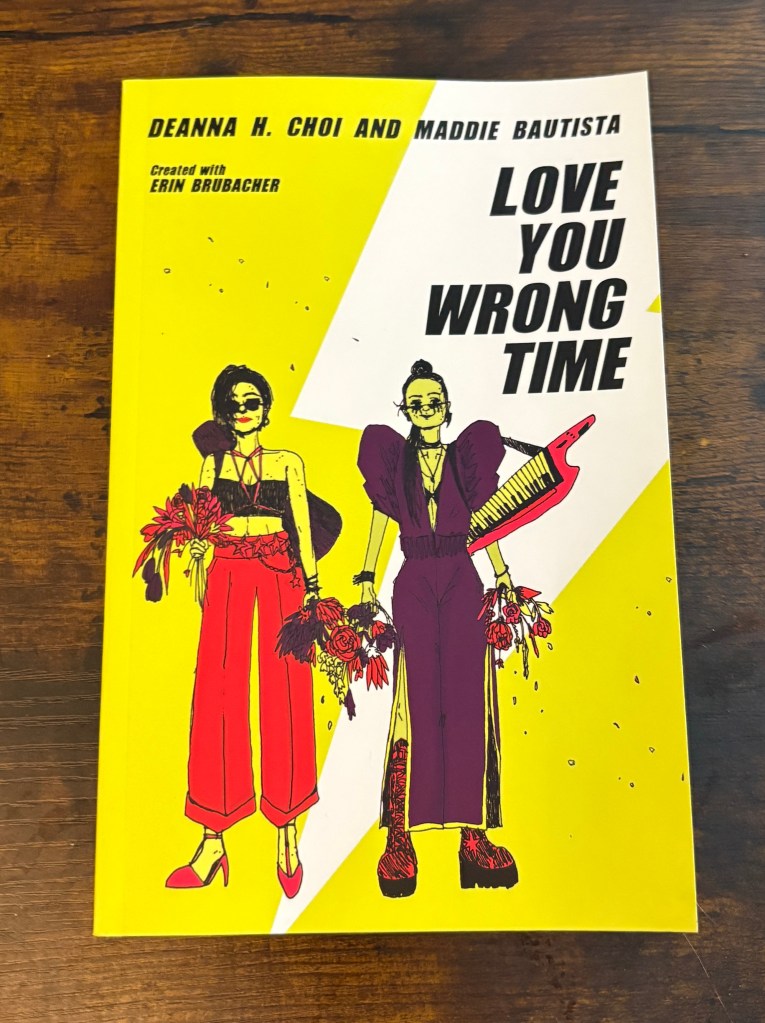
In “Love You Wrong Time” theatre and sound artists Deanna H. Choi and Maddie Bautista pervert the sexual stereotypes about Asian women with almost mathematical precision. Their cabaret style songs are presented with an edged humour that leaves you both laughing without restraint and the tiniest bit uncomfortable. Judging by the book, their performance piece integrates a great deal of audience participation and riffing on what they get from the crowd. It’s a show about image, and so incorporating the crowded, over the top visuals really matters. Choi and Bautista play with public perception, where it comes from and the visceral damage it causes to racialized and eroticized bodies of Asian women. Presented in scenes, each interlude presents a different aspect of Asian stereotypes with a nod, a wink and a clear fuck you to anyone still maintaining these crappy ideas.
From the splashy punk rock cover to the colour photos included within, it is abundantly clear from the get go that the book who put this book together were invested in capturing the dynamic energy of the live show, and it was effective. Probably the best trick employed were the dialogue endnotes between the artists at the end of this scene. They gave the feeling of being in the middle of a creative conversation between minds that have been ricocheting off of each other for years, and catches some of that dynamic in text form. The images of their costume changes also helped to set the scene of high octane performances designed to leave your head turning. It is hard to capture the immediacy of live performance in dead tree edition, but this volume gave it a damn good try. If I was in the slightest bit musical, the scores at the back of the book would have added another level of interest to the experience.
Deanna H. Choi and Maddie Bautista are clearly powerhouses with the energy to rock a range of themes, costumes and ideas in what comes across as a cabaret style performance. Every last detail attests to a creative partnership that is both rich and fulfilling in which they know how to play together to a crowd. If I got nothing more from this text than an appreciation for their creative friendship, I would still consider it worth the read. This is also where the notes come in – I highly recommend not skipping them as they actually offered some of the most interesting and nuanced commentary in the book.
The fact that you can feel that chemistry through the printed page is impressive, but it did leave me wondering who this particular book was for. The performances and detailed interactions described within are so incredibly specific I wondered if it was possible for other performers to replicate it. If it’s intended to be a commemoration of performance pieces by the duo for people who have already seen the live show, it catches that sense of excitement. On the other hand if this is supposed to be a duplicatable script, then I’d say it is much less successful. I question if anyone is ever going to be able to deliver the mad and distinctive energy of these artists well enough to perform the whole play. On the other hand, the inclusion of music means that playing individual scenes or numbers is more possible, and potentially even rewarding for fans of the original work. It all comes back to the hybrid nature of this text: part commemoration, part reproducible script, a lot of captured vibes.
One of the big differences between reviewing a published play and a performed one is potential; a good published play makes you believe that it’s worth taking out and mounting a production out of it, whereas a performed play is judged on how well they drew on the potential that was already there. This text convinced me that these are artists worth following and a performance worth catching. They did not convince me that anyone could make this play work other than the two of them. Is that a failure? I don’t know.
The strengths and weaknesses of this piece are very much tied to the overall cabaret feel. Not all numbers are equally strong, but I can guarantee that the ones I liked are not necessarily the ones that resonate for other people. For example, I liked “The History Song” that gave context to the historical origins of the submissive Asian stereotype, I loved the recreation of Full Metal Jacket, and I thought the “Microagression Drinking Game” was brilliant. These felt like elevated conversations I have with my friends who are people of colour about how you survive and laugh at how deeply ridiculous racism really is. On the other hand pieces like “Mukbang” and “Body Currency” I just found less interesting. At the same time, it’s the live voice that animates which makes for a performance.
The camaraderie of the piece is its strength, but also placed a limit for me on the emotional depths we could reach. This is funny stuff, material that leaves you thinking and a little uncomfortable afterwards. That is something it does really well. On the other hand, some of the ideas they presented were interesting enough I wanted them to explore them for a while longer, but instead it was on to the next idea. You can’t blame a cabaret style show for being a cabaret style show, but it did leave me wishing I could see what Choi and Bautista could do with a longer format.
I know that this script is really fun, occasionally poignant, and thought provoking. Reading it I had the definite thought that the exotification of Latin American women is nothing compared to that of Asian women. And it made me want to experience the beauty of building a creative partnership like that Choi and Bautista clearly enjoy. This book is a worthy product, but I leave it for you to build your own relationship with this text.
Daniela Smith-Fernandez is Chilean-Canadian by birth, francophone by choice. She is an artist, writer and craftsperson who is proudly multicultural and multilingual (English, Spanish, French). She has worked in theatre as a costumer, prop maker, venue manager and volunteer. Her theatre reviews and articles have been published in student newspapers and blog. She is currently writing the second play in a trilogy about a pansexual man who is obsessed with sex and French grammar, not always in that order. She writes in English and French.


Leave a Reply