By Emesha Boyko
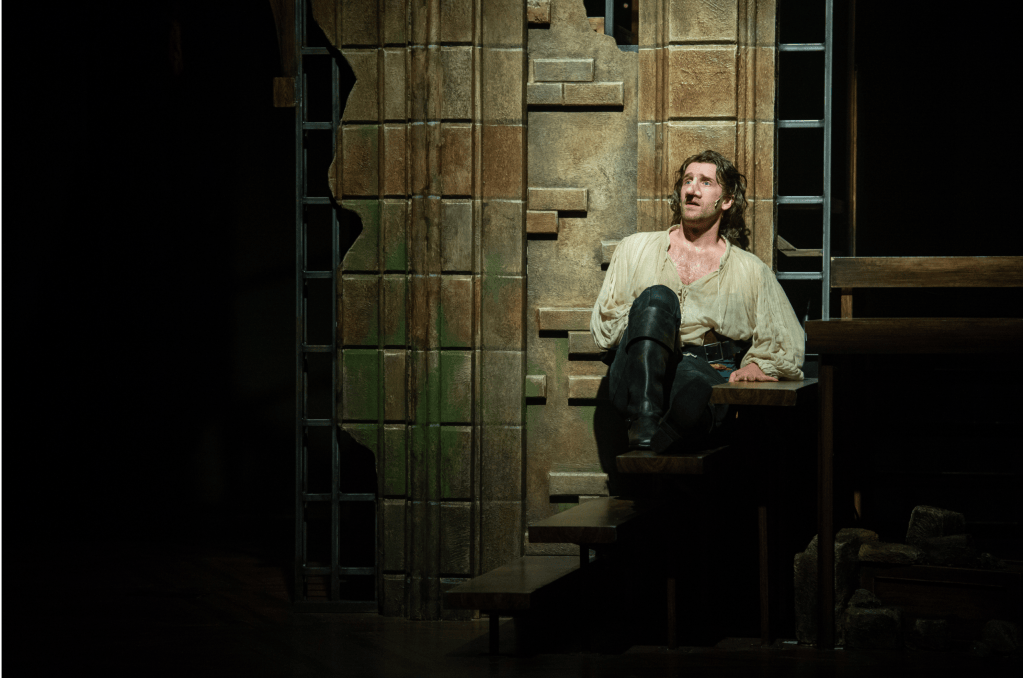
Jessy Ardern’s adaptation of Cyrano de Bergerac is a spin on a classic I didn’t know I needed. As a Deaf and Autistic theatre-goer, I found that I was viewing this work through a disability lens. Upon reading Rosand’s original play, Ardern described falling in love with Cyrano. She met a “ferociously funny, terrifyingly self-destructive man… whose defining characteristic is a consuming, unshakeable rage: at hypocrisy, at classism, at the barest hint of moral compromise.” This black-and-white thinking and strong sense of justice combine with Cyrano’s savantism to offer an Autistic-coded young man. It also causes problems for him as he is deeply in love with his childhood friend Roxanne and is unable to tell her. This parable about a man’s insecurity getting the best of him now has a relateable origin in the unending trauma that accompanies growing up different (read: neurodivergent).
The play’s opening throws us in head-first to an experience that is momentarily overstimulating. After a minute, having acclimated to the rhythms of this world, we are transported to the world of 17th century Paris. This production of Cyrano de Bergerac is sensory joy; it glimmers. Director Amanda Goldberg utilizes the balconies at MTC’s John Hirsch stage so that ee, the audience, have been written into first scene . Elaborately garbed onlookers heckle the actor Lignière, spotlit in embroidered, flowing pants. His repartee with Cyrano gives way to the titular character introducing himself, neuroses-forward.
Cyrano confesses to loving Roxanne to a friend but not to her. This inability to directly express his feelings could be informed by several factors: a desire to do what is logical, even to one’s own detriment; emotional alexithymia (intense difficulty recognizing and processing one’s own emotions); a reluctance to embrace the change in a relationship – how would he have to adjust to the expectations on Roxane’s lover, after living so comfortably as best friends?
Immediately upon meeting Stephanie Sy as Roxane, her incandescence is apparent. Far from the two-dimensional Roxane of yore, this lively, self-empowered woman captivates the viewer along with Cyrano, Christian, and de Guiche. As the classic web of romantic deceit is spun, this town’s culture is depicted as secondary characters are presented in situ. When the boys of Gascogne burst on to the stage to heavy, trap-inspired beats, their camaraderie and boisterous energy are infectious. Several narrative strands are interwoven as we shift from listening in on conversations between Christian and Cyrano, Roxane and Marie, and as we watch Comte de Guise’s contortions under his scheming. Brian Hammam’s performance as an antihero was riveting; his demeanour, dress, and movements gave a superverbal description of his moral arc.
While watching Cyrano channel his otherwordly gift of poetry only to benefit his friends can be a head-scratcher, viewing him as Autistic with profound Rejection Sensitivity Dysphoria might explain his behaviour. He knows that romantic love is possible, and he recognizes it in Roxane and Christian, but 21 years of endless othering within his community have left him psychologically broken. Jack Davidson’s Cyrano is an intriguing enigma, as he alternates between assurance, when engaged in either of his special interests, and a hapless, walking mental breakdown in most other contexts. Cyrano has identified himself as a facilitator, a helper, and above all, a good friend. Watching this absurdly talented man torture himself is perversely exquisite.
For his part, Christian’s asymmetrical scattering of skills could suggest a learning disability and/or communication difference. His bumbling efforts to craft even a single rhyme set him apart from his peers, and we quietly cheered him on as he demonstrated a sincerity usually beaten out of a person before they reach adulthood. His conspiracy with Cyrano is unquestionably problematic, and yet his pure heart shines through. He really does feel all those things his friend writes for him, but he would never be able to express them. When Christian has a breakthrough and reflects on the way he shows up in society, hindered by his perceived intellectual inferiority, we are invited to muse on how things might have turned out differently for him, if he’d had educational supports. Everyone knows a kid who skated by through school, copying friend’s work and masking dyslexia. Neither Cyrano nor Christian are physically or intellectually disabled, but their differences have resulted in them being Othered by society.
In a pivotal scene, atop rickety stairs in a bedroom perpetually lit by a full moon, Roxane pines. Her sharp with and passion for wordplay set her apart from her peers. It’s not just romance she longs for, but to be understood. She’s too smart, too spirited and wilful to fit in to the narrow niche women are given. She finds workarounds to the omnipresent threat of misogyny generally, and specifically evades the malevolent intentions of specific men by thinking outside the box. In Ardern’s rewrite, Roxane’s naïveté is earned. Every time she spots a red flag, her quick-thinking best friend is able to gaslight her anew.
Finally finding a mind that’s on her wavelength, that can keep up with her hyperlexia, feels like everything has fallen into place. Roxane, being seen by the letter-writer, experiences a deep sense of belonging along with intellectual stimulation. Gifted children often spend much of their time alone, unable to align with their peers, and often act out destructively, or develop neuroses. Social morés around gender norms (especially then!) would have prevented her from enjoying much time with Cyrano during their teen years, as well as confined such a brilliant girl academically, socially, and psychologically.
Between the simple sets and resplendent costumes, the evocative music and fresh “verse-ish” flowing rhythmically between actors, this telling breathes new life into an old tale. Touches like the graffiti in the pub, layered shadows, and letters strewn about in the chaos of war made the stage ripple with meaning. Ardern’s nuanced writing highlighting (finally!) strong female characters and the deep-seated insecurity at the core of humanity.


Leave a Reply