By Daniela Smith-Fernandez
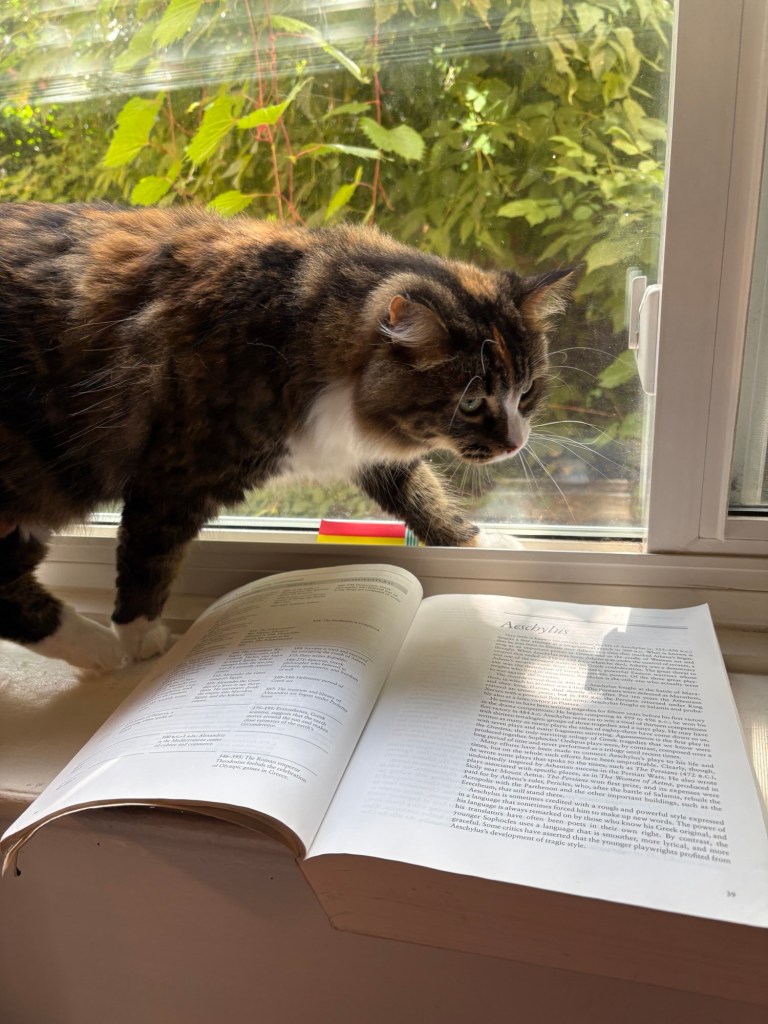
Confession time: I do not have a theatre degree. In order to compensate for this shameful lack on my part I am reading the Bedford Introduction to Drama from cover to cover in the interests of filling in the gaps of my knowledge. This feature will be interspersed with other pieces such as play reviews and topics in theatre. I hope you enjoy coming along on my journey to cram a theatre education into my brain with a 4th edition copy I acquired from someone second hand!
Greek theatre is one of the things my ADHD brain has hyper-fixated on over the years. It also happens to be the very beginning of Bedford Introduction to Drama, regardless which edition you look at. The fact the Western theatre tradition began with the Ancient Greeks is one of those generally uncontroversial statements everyone and their dog (or cat) make at some point when they write histories of the THE-A-TRE (grandiose voice absolutely required for correct pronunciation). I love it with the devotion of the eleven year old girl I was when it first crossed my path. My cat Noisette had a few things to say on the subject too, but she is also a very vocal lady who is mainly interested in telling me about how cool her cardboard box is. Anyways.
The first play in the book is Agamemnon by Aeschylus. Unlike other classics of Greek tragedy, I have absolutely no prior experience of this one. On the other hand, since it’s based on mythology, I did have the benefit of knowing the bones of the story. It is an offshoot of the Trojan War epics, so I apologize for the recap to those who can already tell you these stories in their sleep.
Ignore this if you choose to. You have Troy, a proud kingdom with a prince called Paris who isn’t good for much beyond appreciating pretty people. Literally – the goddess Aphrodite promises him the most beautiful woman in the world as his wife, never mind that said woman, Helen, happens to be married to King Menelaus of Sparta. Paris doesn’t care so they run off to Troy together. Then all of the Greek kings banded together to bring her back… or tried. Agamemnon, Menelaus’ brother was all set to sail off to war, except that he had angered a god and there were no winds. To appease the really awesome compassionate gods, he decides he needs to sacrifice his daughter Iphigenia, as you do (?) The Greeks get to Troy, demanding to get Helen back but Trojans refused… so they fought for ten years, during which time many things happen you can learn about with a decent Greek mythology textbook instead of depending on a theatre nerd recapping a textbook. When the play starts, Agamemnon has come back home after ten years away at war, and his wife Clytemnestra is still holding a grudge from him murdering their daughter. That’s where the audience comes in.
As a play Agamemnon has a different structure than other tragedies, particularly in relationship to what the audience knows. Here, Clytemnestra goes on and on about how happy she is to see her husband and what a good queen she has been. If you read this play at face value without the help of annotations, you are going to miss that EVERYONE seeing this play knows she is lying through her teeth unless the very last few speeches. This is where consuming art from another time and place gets so interesting – we’re faced with work that depended on the audience having familiarity with narratives that we probably don’t – or not unless we are Classics majors. It isn’t just what they knew, but also the degree to which these stories were internalized that can’t be recreated. We can’t recreate their cultural references. By its very nature, reading these texts is embarking in a complex translation project where we are forcing ancient stories into a contemporary framework. The question becomes: is it still worth reading these plays when there is inevitably so much we’ll get wrong?
I would argue that yes, there is still value. Translation is imperfect, but it is still invaluable in helping us appreciate that the world looks different from different angles.
In the beginning, the old men of Sparta are excited about their king coming home. Everyone goes on and on about what a perfect queen Clytemnestra has been, especially Clytemnestra. Then Agamemnon comes home with Cassandra, a former Trojan princess who is now a slave girl. Cassandra has ominous things to say about the future, but no one listens. Agamemnon takes a bath – at which point Clytemnestra kills him. Her lover then shows up and gloats like a cartoon villain about taking over the throne. Everyone calls for justice and just kingship, but that will take until the next play in the trilogy.
What struck me with this play was the distinctive nature of tension. Everybody knows what has and will happen, so what Aeschylus does is essentially freezes the story in one moment and digs deep into the ethical dilemmas at work. Agamemnon is a returning hero to the old men of Sparta, and those concerned with good state governance. On the other hand, he did this absolutely heinous thing by sacrificing his daughter, and no one denies that this was also terrible.
The trick is the balance between bad decisions, and breaking down the considerations. The murder of Agamemnon is horrific, but is it balanced out by the motivation of revenge? Clytemnestra took a lover while her husband was away, and so Agamemnon’s death now also means that the land is in the hands of a tyrant. How do you balance personal with social responsibility? I fight with these questions in every Greek tragedy, but more than usual with this one because of the fact Clytemnestra lies about her motivations. It’s really not about Agamemnon at all – it’s about the impact on Sparta the weight of his decisions have had. It’s about the space created by Agamemnon, not the man himself.
And as a playwright, how do you build tension when everyone knows what is going to happen? How do you make their speeches compelling on their own but also push forward the plot? What is the aesthetic value of having a chorus repeat lines together – do they speak for the collective, or are they intended to be special interest? I know that I love the ritualistic feel of Greek tragedy, the sense that you are going to spend the play deliberating on why things had to come about the way they did. It’s a meditation, a cry for justice. A conversation on what could have gone differently, and why things came to a point of inevitability.
At the end, Agamemnon is dead, killed in the bath. Iphigenia is long dead, killed by her father. Cassandra, princess of Troy and slavegirl of Agamemnon is also dead. Sparta is now controlled by a tyrant. And the question remains: was this inevitable, or the product of some seriously bad decisions? I want to consider that question in every play I read from here on in.
One of the interpretations I’ve read of the Iphigenia story comes from scholars Kenneth Atchity and Elizabeth Wayland Barber. To them, these myths of women came from a different cultural context, specifically a matrilineal society. These myths then got integrated into the artistic production of a patrilineal society that came and took over. This is where motivations are confusing. To them, the death of Iphigenia is unforgivable because according to matrilineal law she would have been Clytemnestra’s only heir. In other words, what her husband took away from wasn’t just a child but the continuance of her line. Which makes the death a political blow as well as a personal one. This does make sense in my reading of the play… but also your husband killing your child is objectively terrible and I think we can already ruminate on the whole situation without the use of my anthropology degrees.
I’m trying to go slow with this project, read plays one at a time. So far we’re up to a good start…
…as long as my cats grant me access to my textbook!
Daniela Smith-Fernandez is Chilean-Canadian by birth, francophone by choice. She is an artist, writer and craftsperson who is proudly multicultural and multilingual (English, Spanish, French). She has worked in theatre as a costumer, prop maker, venue manager and volunteer. Her theatre reviews and articles have been published in student newspapers and blog. She is currently writing the second play in a trilogy about a pansexual man who is obsessed with sex and French grammar, not always in that order. She writes in English and French.


Leave a Reply