By Daniela Smith-Fernandez
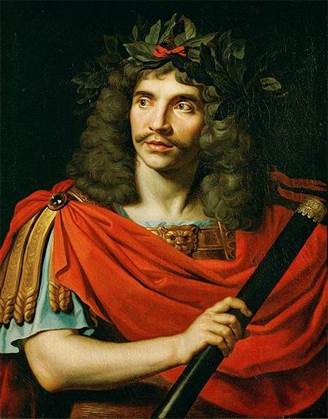
The guy in the painting next to this text is “Molière”. If you know, you know.
As mentioned before, I am reading through the Bedford Introduction to Drama, a text containing plays and articles designed for first year students. In the introduction they did an overview of the important playwrights and movements that are important in theatre history. For the most part it was as you expect – sooooo much Shakespeare, some notes on how little Greek theatre actually survives, medieval mystery plays… and then it came to Molière.
Guys, this textbook only gave him one paragraph!
I felt deeply indignant. A couple lines, that’s it?
There are moments where I understand all at once that the fact I live a lot of my life in French has changed my perspective on things. It’s not just a language I speak, it’s the culture I navigate in as well. Such as the moment when you find yourself shouting at a drama textbook for its exclusion of Molière, who is obviously too important to be slighted in such a way!
So who is this guy? Short answer: French playwright who is brilliant and writes fantastic critiques of manners and society. I admit I don’t know as many of his plays as I should, but I can also say that about Shakespeare. They are fun and witty and often bawdy and totally one of a kind. You want to get into his actual history and you can do the same google search I did. His biography is not the point.
The point is the place he occupies in francophone culture. French is quite often referred to as “the language of Molière”, Hell, I use that line multiple times in my own French language play as a punchline. His work has parallels to Shakespeare in how it shaped the living language. His work is more than just an important pretty piece of art to look at – he actually had an irreversible fundamental impact on French as it exists today. We speak the language of Molière because that’s how crucial a symbolic place he holds in the language community.
Then we get to an English language textbook with the usual idolatry of Shakespeare. (Guys I love Shakespeare but he’s not the only influential writer out there!) There Molière is a side note between the medieval mystery plays and maybe a couple lines about Christopher Marlowe. And my logical brain understands that this makes sense, because in English language theatre… that is the place of Molière. They give even less attention to Calderon de la Barca, and if I’d done my theatre education in Spanish I’m pretty sure I’d be having feelings about that too. Yet for the people who put this book together, these made sense in terms of anglophone theatre culture. I can’t fault them for that. I mean I did, viscerally, get upset about Molière but I do intellectually appreciate the exclusions.
This is a textbook case of why I think it’s so important to learn deeply and profoundly that the world looks different from different perspectives. Would anyone who hasn’t had exposure to francophone culture get indignant about the exclusion of Molière? It’s unlikely. My reaction comes from a place of being immersed in a culture deeply enough to have gut reactions. But for a good amount of time before the logic brain kicked in, the exclusion of Molière invalidated this textbook as a legitimate source of knowledge about theatre history.
You don’t have to be a language geek or even multilingual to benefit from understanding the role that a language plays in people’s minds, hearts and imaginations. Translating from one language to another is not just a matter of switching between two different parallel codes – it’s figuring out how to integrate the references and symbols that are embedded in the language itself. Even if you’re reading a translation, you can read the translator’s notes or look up references you’ve never heard of. That too is part of multilingualism and reaching beyond your own position in a language and culture.
Why stick to work from one language or culture when you can taste the intricacies of so many others on your ear and on your tongue? It would be like eating only one meal for the rest of your life.
It occurs to me that I did not actually add Molière to my Cultural Guide for Anglophones on the program for my play. I’m going to go and add a very abridged version of this now…
Daniela Smith-Fernandez is Chilean-Canadian by birth, francophone by choice. She is an artist, writer and craftsperson who is proudly multicultural and multilingual (English, Spanish, French). She has worked in theatre as a costumer, prop maker, venue manager and volunteer. Her theatre reviews and articles have been published in student newspapers and blog. She is currently writing the second play in a trilogy about a pansexual man who is obsessed with sex and French grammar, not always in that order. She writes in English and French.


Leave a Reply