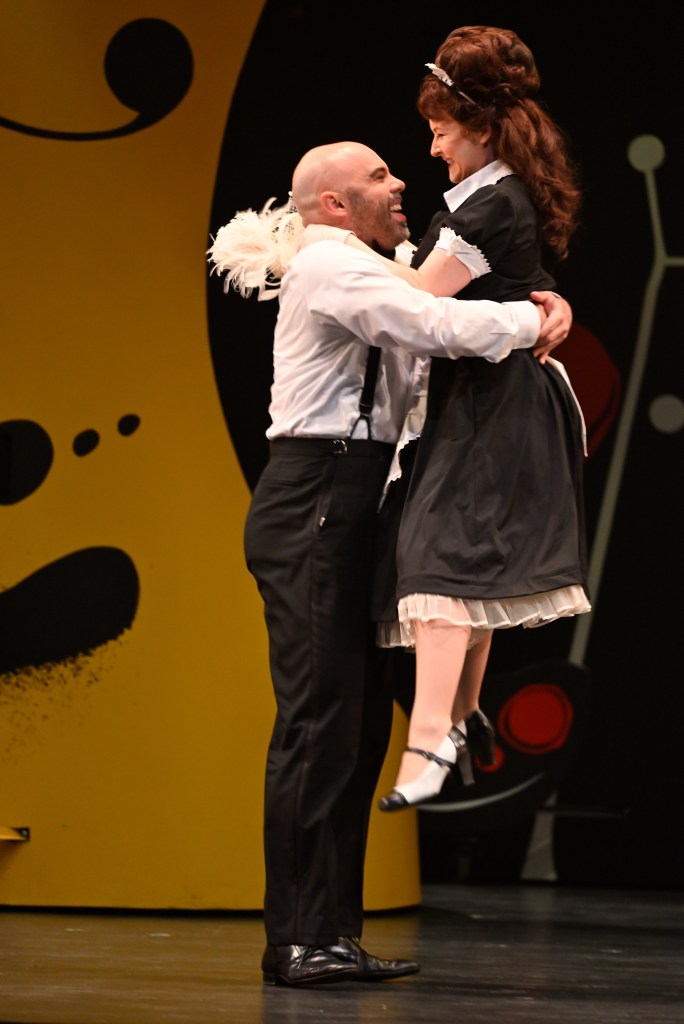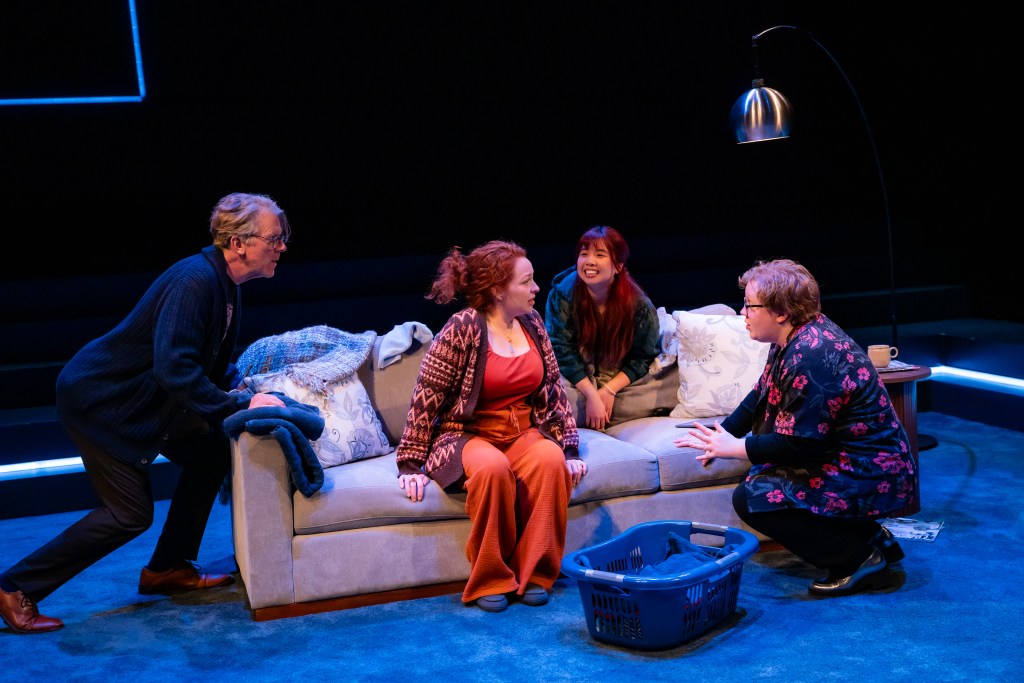

In this production, actor Tom Rooney switches between a staggering number of parts to tell a story of how Rogers communications is actually worse than you could have imagined. Yes, even after being switched between operators for forty five minutes because you want to make a miniscule change to your cell phone plan. In front of a set that suggests both a board room and also literal hell, the actor fleshes out the intersection between family and corporate dramas whose result is consumer helplessness and lack of choice. Isn’t free market economy capitalism delightful?
It’s worth saying right now up front that I am emphatically not the intended audience for this play. My personal politics made it hard for the ideas in this show to line up. If you want to know more about why, I’ll be discussing them more today at 16:40 on Envol Radio with Skylar Bélanger.
To the credit of playwright Michael Healey, the script does an excellent job of breaking down big economic concepts, like the role of competition and created scarcity. At the beginning of the show the screens show that this is not a work of journalism but a work of fiction; I would argue that it still carries the feeling and weight of investigative reporting. The storytelling is just that, a lot of telling and informing about what has gone on with the feeling that this is capital T Truth as opposed to an artistic rendition. This is contributed to by the set, which leaves you feeling like you are on a conference call you can’t get out of. It’s like being in the audience of a presentation, albeit a well done one, that you aren’t sure if you signed up for. It seems like the intention is to use the tools of the corporate world against it, but it still read as the corporate world.
One of the main themes of the show is that the personal issues of Edward Rogers with his father contributed to the corruption. The story as they present it follows the familiar tropes of emotionally abusive distant father resulting in an entitled socially maladjusted child. The backhanded dealings and relationship with the board contribute to a climate where the theoretical checks and balances are incapable of working. At the same time, the show also shines a line on how the federal government is implicated in this mess. A sad little boy who wants his dad’s attention is one thing, but it only means something once his power moves are backed up by big institutions.
I won’t give any spoilers, but I found the last scene of the show incredibly problematic to have on stage.
What is clear is that this show hit a chord with a lot of the audience the night I was there, judging by the number of standing ovations. If you are someone who likes to look at systems and is interested in ideas of competition and economics, this will speak to you. If you enjoy Mark Carney’s speeches and market analysis, this show will appeal to you. It probably has a similar appeal to tv shows about lawyers and people trying to Get Ahead – and there are lots of people who like these things. It wasn’t for me, but then again there are a lot of shows out there that are. We should all have stuff that makes us happy on stage.
Royal Manitoba Theatre Centre Carrie – Jessy Ardern† Paul – Daniel Bogart Rudy / Jim / Garry / Officer Miller – Toby Hughes Alice – Jennifer Lyon Rachel / Ms. Watson / Nurse / Officer Lafleur – Jane Testar
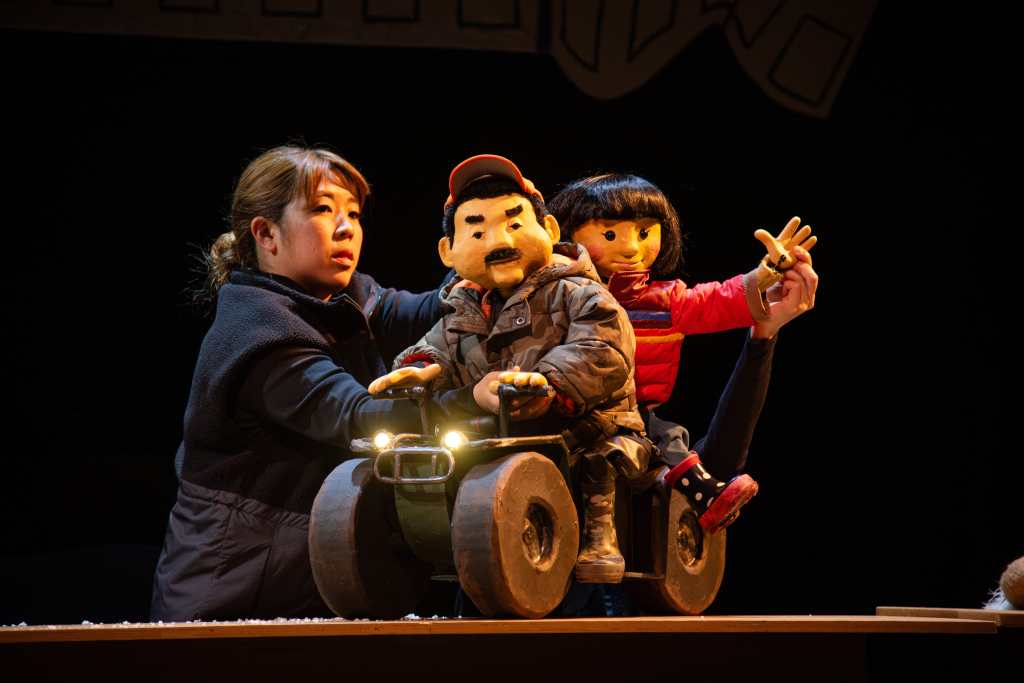
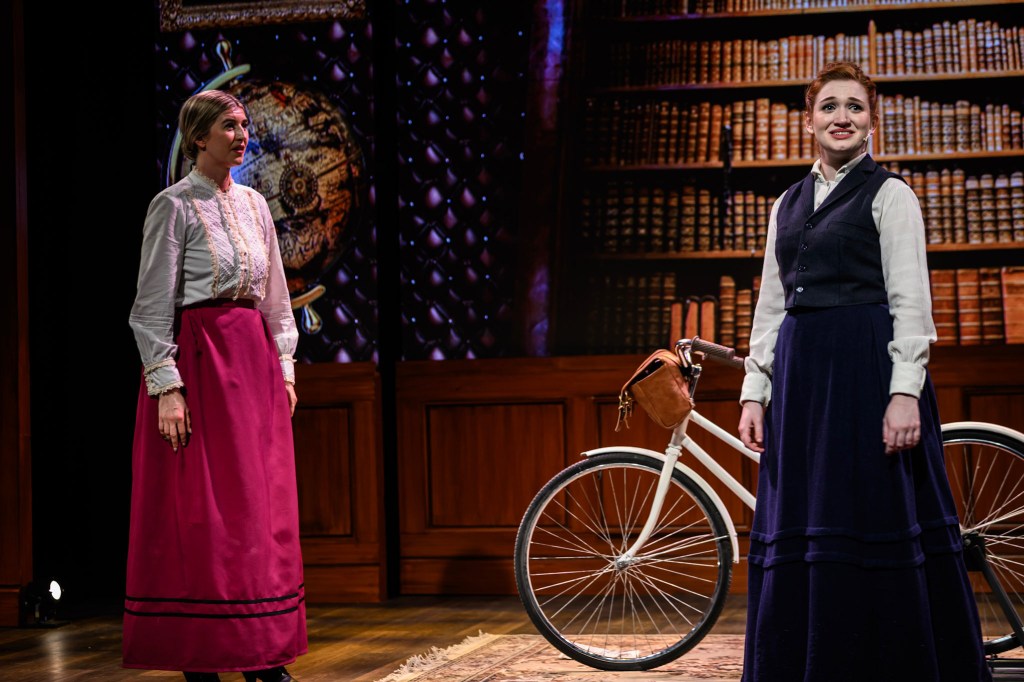
The tagline of this show could almost be “it should have been so simple”. Parents Carrie and Paul just want to take care of their two kids, one of whom, Daniel, happens to have cerebral palsy. Beyond that they work, pick up groceries and squabble. And yet in some achingly painfully realistic first scenes, the audience is brought into the fact that their lives are full of stress levels and logistical disaster paradigms every time they try to accomplish some basic task to help their child with special needs. Of course the clinicians and medical bureaucrats Carrie and Paul have to go through are very sympathetic to how hard it must be raising a child with a disability, conveniently managing to ignore that it is the all too real world of Mandatory Bureaucracy for Everything that is actually the source of their stress. Actually, it’s worth mentioning that at no point do either parent attribute their difficulties to their child’s medical condition. It’s suggested that it’s not because it isn’t a factor, but rather because it absolutely pales in comparison to the challenges of accessing the services. They have needs that other families don’t have, which is supposed to be balanced out through systems that give them additional supports. And yet. Insert the dry laughter.
This show took on a big topic and turned into a fast-paced chaotic zinger of an adventure. If you have ever had to deal with medical bureaucracy I would say that the first twenty minutes are almost too real and brutally honest. These initial scenes are some of the best writing in the show, with their concise analysis of splitting hairs and ridiculous expectations placed on families. Kudos to Tobias Hughes for delivering the doctor’s lines with the friendly smirk of someone who truly believes that they are being helpful. If you have never been at the mercy of medical bureaucracy, the initial segment is a beautiful insight into the experience of repeated frustration that wears people down. The overall theme of systems taking away human dignity is all too relatable. Also, there is some fabulous examples by the establishment of what my friend calls “kale smoothie and yoga” your problems away – or in this case, offer trite visualisations and trite metaphors instead of offering meaningful help.
Dealing with bureaucracy is often very much like trying to box with jello. You hit it hard with logic and it just goes ahead and suffocates you further. Except in this particular case, Carrie decides to take some concrete action in very unexpected ways. Is it realistic? No. That was never the point. Instead, it gives the audience a feeling of power and catharsis. In this show, the characters get to push back and make things happen. There is a radical purpose served by imagining an alternative ending to what often happens, and that is what this piece gives us. Beyond that I’m getting into spoiler territory.
I would give this piece one of my ultimate compliments, which is that it is well crafted. Every element works well together. The actors are generous in how they interact with each other. The pacing of this show is stellar. The script is tight. It is high up there in the list of favourite shows I’ve seen since starting this blog. I particularly loved the parental support group online played by Jane Testar and Tobias Hughes. The two dash between personas for much needed comedic relief, but also anchor the story in important ways. Jesse Ardern is the heart of the story, a protagonist who consistently goes haywire without ever giving up her relatability and loveable quality.
Partly because this show handles such a big topic, it’s inevitable that it also raises questions that are worth examining. For example, how does it shape the story that the character with a disability is never shown on stage, situating the able bodied parents at its centre? It’s possible that including disabled actors might be equally problematic if they are presented as objects of spectacle, but I did spend a lot of time thinking over various alternatives.
I’m also uncomfortable with the way blame is situated for systemic inaction. To be clear, Alice their worker is clearly an awful person and I enjoyed the catharsis of someone in an unequal unjust system get their comeuppance. That said, even within the world of the play, nothing that happens to her is going to change the fundamental problems of inadequate resources. It also seemed like there was a grain of truth in the worker’s criticism that the white nuclear family was privileged – which was not in any way to dismiss the severity of their challenges. I wondered why Daniel the disabled child had to be consistely refered to as “such a good kid”, as though he would have been less worthy if presented as human and fallible. I was just left wondering what would happen if other elements were brought in as well – ethnicity, welfare, language, immigration, disabled parents for example.
None of that takes away from how much I liked the show. It’s great that I walked out with questions about representation and individualism. I wondered what the next show about disability will look like, and how they will engage with those big questions. And I wondered about how you can bring progressive values into a mainstream theatre that still has to appeal to a broad base. I do appreciate that community plays a key role in the resolution.
So to sum it up, great play, but I would love to discuss the issues that came up for me with anyone who goes to see the show.
Erica Wilson is not prepared to live in anyone”s artistic pigeon hole. The best part? In her February 6 show “Miss Carcass Caresse: Soft Waters”, at Kiyanaan Indigenous Theatre Festival she gets to define the terms in which she creates as, well, an artist. This year’s national indigenous arts development and showcase recipient has created a piece built around her burlesque persona. Equally importantly, it also allows her to break down other boundaries within her creative practice -she describes the show as “actually six distinct unique themes with six unique art styles”. I, for one, am drawn to the promise of burlesque, puppets, circus and water imagery all in one show.
This is the kind of work that comes about when artists are given space to explore their own voice because absolutely no one else in the world is going to mix up this particular concoction. And yet. In our interview Erica Wilson described frequent experiences in the arts being pigeonholed as an indigenous performer, not allowed to branch out past ‘indigenous’ roles. Situations where the opportunities stopped the moment she was interested in not exclusively being identified by ethnicity. It’s the age old problem of thinking that art by minorities can’t also be universal, which is an old story…
“When you’re an indigenous woman that has power in community and power around people, you’re supposed to be modest. That you have to be completely wearing the ribbon skirts and have the feather, and that’s really lovely but that’s also a huge pigeon hole that is boxing people in” -Erica Wilson
It’s far from a radical idea that artists need to follow their own creative voices. Marginalized voices, and indigenous voices even more so, need to be allowed to say what they want to say following their own creative voices. In other words, not just continuing to put out the narratives about ethnicity, or gender, or well, anything else. we’ve all heard before. In Erica Wilson’s description of her ecclectic show: ““I had the mental space, I had the time, I had the energy and also I would call it sacred rage to be like I’m going to complete my tasks”. Even better, this sacred rage is going to fuel something both sexy and funny. Honestly, is there a better way to process an artist’s thought provoking ideas than laughter and titillation?
Burlesque seems like a natural place for someone drawn to “big abstract things” such as Catholic imagery, gothic culture, surrealism and circus. Erica Wilson explained that burlesque performers impressed her “knowing that none of them had to play within their gender or their race”. The genre represented a way of escaping some of the rigid constraints she has struggled with. According to her, “eventually with my rage I was like you know what I can do this too”! And she did. And she has. Across Canada.
The unusual moniker “Carcass Caresse” fits in part because it celebrates “just the weirdness of being this fleshy bony thing”. Caress is soft and sexy, but carcass is a reminder that we are in the end, just bodies. An appropriately distinctive name for a very distinctive artist.
Le multiculturalisme canadien est devenu l’un des défis les plus importants de notre époque. Contrairement à certains , on a une population qui incarne une diversité d’histoires et de perspectives sur la question essentielle : « au Canada, ça veut dire quoi ? Appartenir authentiquement dans ta pluralité ? C’est le point de départ de ce nouvelle œuvre « Ô Canada, té qui toi ? » par Alison Palmer LacinaDembélé et Ramatoulaye Cherif.
L’histoire est se déroule dans une petite ville, quelque chose qui influence beaucoup le déroulement. Alison Palmer a expliqué qu’il y a des éléments qui viennent de son expérience d’enseigner au rurale quand les immigrants ont commencé à arriver en masse. L’enjeu de comment mieux accueillir de nouveaux arrivants est souvent contesté, mais pour Lacina Dembélé « l’accueil se fait par des gestes ». Pas un grand geste symbolique, mais des gestes quotidiens vers les autres, les inconnus. C’est bien possible de voir ce message dans la pièce .
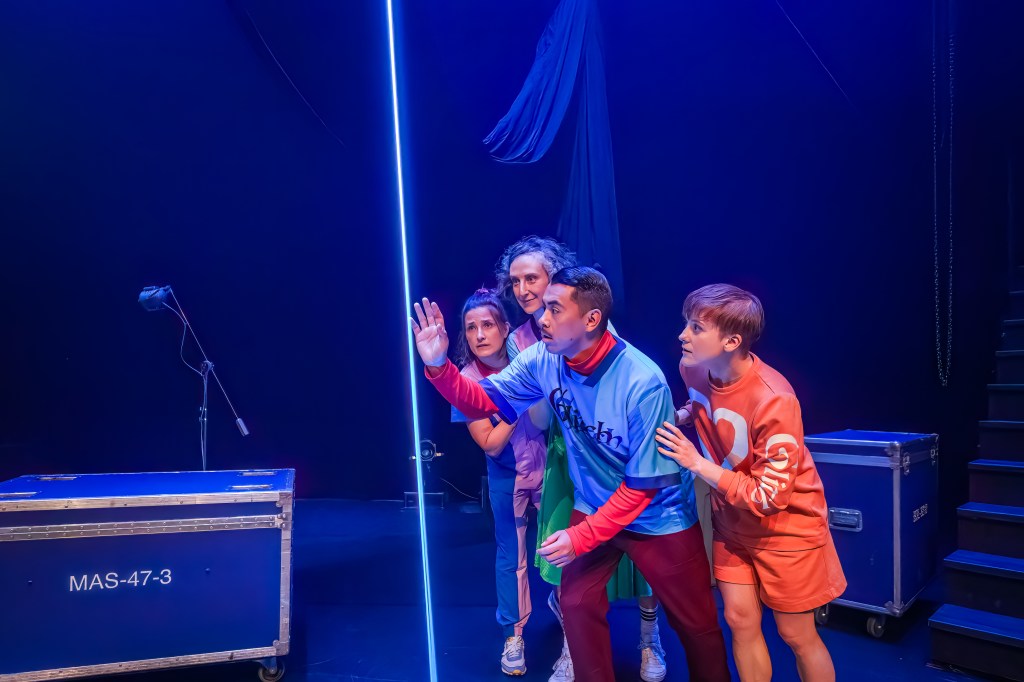
Créée explicitement pour des étudiants de l’école secondaire, la pièce met quatre personnages avec des points de vue distincts dans un autobus dans une tempête. Sans autre recours, ils trouvent la capacité d’avoir de dialoguer à propos de sujets comme la nourriture, la musique et leurs relations avec leurs familles. La pièce réussit à inclure aussi des éléments interactifs comme le rythme, des mouvements et de la poésie slam.
C’est une pièce qui ne présente pas une seule vision d’appartenance, ni du Canada. Pour les gens qui sont enracinés dans plus qu’une culture, y compris moi, la question d’identité n’est jamais superficielle. Si tu es souvent frustré avec la vision du multiculturalisme présenté dans la société canadienne, tu vas bien apprécier cette pièce. Les discussions entre les quatre personnages ne sont pas de simples archétypes, mais des interactions qui viennent des histoires spécifiques. Ce n’est pas l’histoire de n’importe qui – c’est quatre individus, deux qui viennent d’un même pays en Afrique, un métis et l’autre né au Canada de parents qui étaient des réfugiés venant d’Afrique. La spécificité aide énormément le public à comprendre qu’il n’y a aucune personne capablede représenter complètement sa culture ni sa position culturelle. S’il y a une façon d’aller vers un futur multiculturel, c’est en comprenant le pluralisme sans réduire des gens à des catégories trop faciles.
Il vaut la peine de vous avertir : il ne vous donne pas une réponse simple à la question qui est Canada. Ce qui se présente est beaucoup plus important : quatre personnages qui vont vous montrer pourquoi cette question est beaucoup plus importante. Selon moi, être un pays qui continue de se demander comment être vraiment accueillant et inclusive… c’est une raison pour être fier de ta patrie.
Ô Canada, té qui toi ? va être présentée à un public général le 6 et 7 février. Contactez le Théâtre Cercle Molière pour des billets.
Photo by Leif Norman. Tad & Birdy by Anika Dowsett Performers are Samuel Benson and Hera Nalam Set, Props and Costumes by Denyse Karn Lighting by Lovissa Wiens Directed by Erin MacGrath
Meet an utterly charming and also unlikely duo, Tad (Hera Nalam)and Birdy (Samuel Benson), and their wonderful friendship. As you can probably guess, Tad is a tadpole and birdy is, well, you can figure it out. We were lucky enough to catch the world premiere at Manitoba Theatre for Young People. This is an example of children’s theatre where the relationship between the two characters is the core of why the piece works as well as it does. It’s got the kind of magic that made you clap your hands if you believed in fairies at Peter Pan.
Birdy lives in the “safest place in the world”, where not much changes from day to day. This all changes when “Tad”, an “aquatic worm” shows up in a glass jar. Whereas Birdy tries to stay safe in the sameness of his life as it is, Tad sparkles with adventure and curiosity to see beyond the horizons of the room where they are situated. As their relationship develops, Birdy realizes that what he has accepted may not actually be what he wants. There are sad bits where the audience feels for Birdy which are handled sensitively in a way that pulls us forward. This is a story about how friendship can help you be brave enough to make incredible transformations happen.
The set and costumes create the world of a child’s bedroom from the perspective of small creatures. The creativity in how the characters use their environment is absolutely delightful. Everything on stage has purpose, and younger children will have a blast guessing how it will all be used. Between the glorious costumes, the oversized painted set and the completely delightful props, it would be easy to get lost in the cute-ness of the aesthetics… but you don’t. It just has a tremendous amount of heart. The incredible physicality of both actors sells it. On one hand you have the particular rocking motion of the bird who flaps and moults and walks in that very familiar bird gait. In contrast you have the more fluid motions of Tad who shifts and changes throughout the show. Their body language conveyed the story of how they had changed without ever losing the quality that made them unique.
I decided to find a child to come to MTYP with me because I, as a middle aged woman, am just not the intended audience for their season. If I judge children’s theatre by the standards of what I like, I’m not being fair. It’s important to find someone who this show is for and let them weigh in. So this is why I offered one of my favourite humans, River Kovacs (10) the job of official Curtains Up children’s consultant, paid in hot chocolate and theatre tickets. This play marks the first time River is working in this role, but she’s already got the theatre bug thanks to a Nana and mom who have made sure she’s exposed to the arts. She has promised to come to the next one. Check out her bio on the contributor’s page.
According to River, this show “makes you feel like anything can be possible!” She also says that everyone is either a little bit more of a Tad or a Birdy in that they embrace change or are afraid of it. She says she is definitely a Birdy but her mom is a Tad. On a scale of bad- not good -okay – good – very good, she rated it as “very good” and says that she would recommend it to her brother and her friends.
In this case, River and I agree: this is a great play. We did both agree that we wanted some more things wrapped up in the ending. For me with my Unwieldy Adult-ish Brain, it was hard to believe that two wild animals with craft supply prosthetics wouldn’t become very decorative predator food. On the other hand, River did believe that it would be a happy ending, but wanted to see Birdy find his flock. Since this show is for River and not me, I’m going to let her have the last word on this one: happy endings for all, and let the whole wide world find them.
The show opens with a couple surrounded by their stuff, a seemingly random assortment of boxes and objects of varying provenance. Comedy duo Matt Baram and Naomi Snieckus are visually and metaphorically overwhelmed by possessions. The storytelling is anchored in these physical objects, alternating between improvised intervals and scripted scenes from the couple’s life. Warning: there is audience participation. There is a loose narrative arc that takes them hauling stuff over the border from the USA, but it isn’t worth your time getting hung up on the progression.
It needs to be said that Matt Baram and Naomi Snieckus are absolutely delightful together. They are both now on my to watch list of comedic talents. Individually they are skilled but together they sparkle. Their quick fire responses are fun, and oh so witty. If they play off each other as well off stage as on, it is not surprising why they have been married so long. I would happily watch either of them in any future theatre productions going forward.
The defining feature of the show is that the actors tell it directly to the audience, essentially breaking down the fourth wall completely. This gave it the feeling of a stand up comedy special with some rehearsed segments. This gave it a coziness, but also a decidedly non-theatrical feel. It ended up feeling like you were having dinner with a really interesting and entertaining couple – enjoyable, but not generally what I go to the theatre to experience. The friend who came with me described it as “a little too long for a fringe play”, and it is a fair assessment of what it felt like – although to reiterate, the actors are incredibly skilled. When it was the two of them, it flowed. When they were drawing out audience participation, it often lagged like a 6 AM line for coffee.
If you have any hoarding tendencies, set designer Michelle Tracey’s landscape of cardboard boxes may provoke serious anxiety. It was glorious, and the interaction with props was extremely well done, but none of that changes the sheer visual impact of STUFF that can absolutely be triggering. If we’re honest, theatre season tickets tend to skew to an older crowd who have most likely had the experience of weeding through a parents’ accumulated possession. That means that for many of the viewers, this show is likely to have a deeper emotional resonance for them than it did for me, and it’s worth acknowledging. If this theme speaks to you, the show will be an appreciated take on a fairly universal experience delivered first person from people who are (more or less) speaking from a place of personal experience. It’s a conversational, deeply accessible show and those have definite value.
My biggest complaint with the show was that I didn’t feel like it delivered any kind of catharsis. I absolutely appreciated why the objects on stage had been held on to, but I didn’t feel like it resulted in any message. When I used to help people with academic writing the question I always gave them was “so what”? In other words, every time you include something, think about what it contributes to the big picture. That was something that ran through my head a lot in this show. I could hear what they were saying about objects, but it didn’t lead me to any conclusion. From what I could tell, the end of the story was that Matt and Naomi were stuck with a house full of huge amounts of stuff from four parents with no real plan to thin it out or get rid of it. If there was more to the ending than this, I would like it to have been clarified a bit. I was left feeling anxious for them, and honestly I have enough stuff worries of my own without needing to borrow anyone else’s.
This is a case of a show where the good parts of it are so good that they make it still worth seeing. If you are a fan of the conversational mode of stand up comedy, this will be appealing for you. If you have had to weed through a parent’s possessions, this will be relatable. It’s great that theatre can speak to a myriad of experiences. I will just be excited for the next production with a narrative thread and a made up story.
Il y a sept ans, mon amie Marie-Ève Fontaine faisait une résidence d’artiste dans l’ancienne maison d’été de Gabrielle Roy, à Petite-Rivière-Saint-François, au bord du fleuve Saint-Laurent. J’habitais alors à Québec et elle a accepté que je m’immisce quelques jours dans son espace créatif, qui a été celui de notre chère Gabrielle. On a fait des randonnées, on a cueilli des fleurs, on a fait disparaître une couple de bâtonnets de pastel, on a jasé littérature, j’ai bu du café et Marie-Ève du thé. On a toutes les deux bu du gin, en se laissant bercer par la balançoire de celle qui nous avait menées jusque là.
Petite-Rivière est belle comme tout, avec ses ciels vifs parfois teintés de roses et de jaunes presque impossibles. Ses forêts, ses eaux et son infrastructure créent des sons qui surprennent. Son monde est fier et généreux. Je suis, comme Gabrielle Roy et Marie-Ève Fontaine, tombée amoureuse du lieu et j’y suis souvent retournée.
C’est ce lieu-même qui se déguise en personnage principal dans le spectacle Cet été qui chantait, présenté au Théâtre Cercle Molière. À vrai dire, la pièce refuse à sa manière le « trop vrai » et l’arc narratif traditionnel – oublions les intrigues, le dénouement et toutes ces affaires-là! Elle repose plutôt sur un univers qui a décidément touché et inspiré une grande écrivaine. La reproduction de cet univers nous invite à voir et à ressentir, en dose plus petite (soit 75 minutes), certaines des mêmes choses qu’elle.
Dès la première scène, on aperçoit Gabrielle Roy (jouée par Marie-Ève Fontaine) arriver au chalet. Pendant plusieurs minutes, elle s’imprègne des détails qui l’entourent et elle prend tout son temps pour trouver ses aises et défaire sa valise. Elle place la table de cuisine où elle la veut, elle déplie une nappe et l’étale sur la table. Elle respire. Elle regarde. Elle remarque. Le ton est donné : « Cette pièce sera lente, habitue-toi. »
Puisque ralentir c’est aussi savourer, le spectateur qui se plie au rythme a droit à tout un plateau de sucreries théâtrales servies par une équipe experte. Celle-ci s’est tournée vers une variété de supports pour recréer l’atmosphère de Petite-Rivière : jeu de marionnette, d’acteurs (Natalie Labossière), jeux d’ombres et de lumière, art visuel, musique et paysages sonores sur scène (Gérald Laroche). Il m’en manque, c’est certain.
Voici une liste non exhaustive des petites merveilles auxquelles je me suis accrochée pendant le spectacle : coassement des grenouilles, lucioles, bleu, boîte à malle, bateau invisible, la gatte de Monsieur Émile, une visiteuse, tchou-tchou, yeux brillants, chants d’oiseaux, rires, quelques bouquets. Même si le vent existait seulement sous les sifflements de Gérald Laroche, je jurerais l’avoir senti, aussi, sous les poils de mes bras.
Vite, rendez-vous au Théâtre Cercle Molière! Vous avez jusqu’au 24 janvier pour découvrir le monde intime d’une autrice d’ici.
Murder on the Orient Express was originally a detective novel by Agatha Christie; it isn’t so much a murder mystery as one of the classics that defined the genre. There is a reason why it has been turned into multiple movies over the years. It gives you our favourite tropes of the 1930’s detective story: set in the milieu of the impossibly privileged classes, you have the wealthy declassé American tourist, the stoic former military man, the governess who aspires to more, the foreign nobility fallen on hard times… I don’t need to list them all because we know them – they have symbolic power in part because of Agatha Christie’s classic works. This production anchors itself beautifully in this created world, and the production is satisfying in the same way as the books that made these stock characters into the classics that they are.
A quick synopsis for those who don’t know the story: Hercule Poirot, a fussy Belgian detective, has finished a case in Istanbul when he runs into an old friend Constantine Bouc who runs the luxury train company the Orient Express. Bouc convinces him to take the train back home with the assurance that it will be nothing but relaxation and luxury – no need to think about crimes. As he meets the other first class guests, Poirot quickly becomes aware that not all is as it seems. He is proved right, because what fun would detective stories be if the detective was actually fallible in any real sense? Ah ha! A JOLLY GOOD MURDER! (As my father would say). Who is responsible ? Who is hiding what? What are the motives? What passions are hidden from view? Come and find out!
This is a very enjoyable show, let me say that from the start. It is beautiful, with set and costumes perfectly capturing the 1930’s aesthetic. It is a show that benefits from high production values, because the world that it inhabits is so over the top. In this version the train feels like another character, sometimes indulging the guests, and other times offering a claustrophobic trap for those who can no longer escape their own pasts or deep emotions. The actors did a great job of conveying this sense of being restricted, helped by an absolutely incredible set that framed them visually as small players in monumental events.
We have to talk about the set. Quite simply, it stole the show. A rotating stage allowed them to shift between locations such as the back deck, cabins and the dining car. Other productions have rotating stages, but I have never seen it used so effectively. For one, the rhythm of the scene changes was beautiful to watch and actually contributed to the feeling of being in motion on a train. Also, every individual set was absolutely perfect, but the transitions were even better. The feeling of shifting from one place to another added to the feeling of this being a puzzle. There is a game called Room I play on my iphone in which you interact with elements on the screen, needing to flip your perspective in order to undo a box and reach at the core secret. This set felt a lot like that. Hats off to designer Brian Perchaluk. I have never been so impressed and taken aback by a set before.
Actor Alex Poch Goldin’s Hercule Poirot carries the show. His version shows the influence of David Suchot’s TV rendition, while also being a sharper and more rigid who accepts neither nonsense or threads left unpulled. This works well with this particular storyline in which he is forced to react to revelations. I did sometimes feel as though it left the impression that Poirot lacked a little empathy in his rush to uncover secrets. It’s not a bad choice, but personally I did feel like I wanted a little more softness. To be fair, this could be based on the fact that I’ve read a ridiculous amount of Hercule Poirot books and have my own feelings about the character.
On the whole, the cast delivered solid performances, hitting the right lines for laughs and playing off of each other well in a way that is absolutely essential for this particular script. One thing I did find was that the characters on stage didn’t give me the feeling of curiousity, of wondering who these characters had been before they jumped on the stage. The exception was Constantine Bouc, played by Ray Strachan. Something about the way he approached that role left me believing that there was a whole other rich backstory to that character which could be revealed given half an opportunity and would be worth a play of its own. This could also be because this play’s emphasis on plot and revelation gave less focus to character development. The drive towards wanting to know what they were hiding kept the emphasis away from learning who the character was. Completely understandable, but it was a limitation.
The staging used for the famous denouement was fabulous. It repeated just enough information without being repetitive, and the lighting and motion perfectly complemented the dramatic nature of the reveal. I almost wonder if it would have been effective to use some of those techniques throughout the story to make the tension increase. For example, would it have been interested to get momentary flashes of what Poirot is thinking throughout the story presented to the audience?
This is a really good murder mystery play. I love murder mystery plays -they are very enjoyable. There is a reason why they are so popular. If you like murder mysteries, you will almost definitely enjoy this one. At the end of the day, this is the message its worth taking away from my review.
There are things that I wonder about, but it’s hard to tell if my criticisms are for the production, or the limitations of the genre. For example, there is a moral question asked throughout the play. I can’t repeat it without giving too much away, but it has to do with a question Poirot tackles at the beginning and at the end. To me, questions like this one are a bit of a Chekhov’s gun: you have to answer, or at least address it, by the end of the play. In this show, Poirot repeats his question, but to me it lacked depth. I feel like ideally, when a show gives me a question like that to think over, I want to leave the theatre still mulling it over, probably even deeply conflicted about what it means. This was not that experience, which is ok, because it was still a really enjoyable one. However, it does leave me longing for a theatrical experience that really leaves me thinking. At the same time, theatre is a little bit like food: you can enjoy different things at different times and still have your individual preferences. Not everyone likes asparagus or puppets. Even if the puppet haters are actually objectively wrong.
So is it worth seeing? Absolutely. This is the right kind of show to see with people who aren’t theatre nerds to introduce them to the artform. This is what you take your mother or grandmother to for a special occasion. Or go to with coworkers so that you can chat about it afterwards over drinks. It is accessible theatre, and there is a huge value to making things accessible.